A True Story
Second-century satirical novella featuring space travel and alien warfare.

A True Story (Ancient Greek: Ἀληθῆ διηγήματα, Alēthē diēgēmata; Latin: Vera Historia or Verae Historiae), also translated as True History, is a long novella or short novel written in the second century AD by the Syrian author Lucian of Samosata. The novel is a satire of outlandish tales that had been reported in ancient sources, particularly those that presented fantastic or mythical events as if they were true. It is Lucian's best-known work. It is the earliest known work of fiction to include travel to outer space, alien lifeforms, and interplanetary warfare, and has been described as 'the first known text that could be called science fiction.'
- author
- Lucian of Samosata
- century_written
- second century AD
- original_language
- Ancient Greek
- genre
- satire, parody, science fiction, fantasy
- known_for
- earliest known fiction with space travel, aliens, and interplanetary war
- also_called
- True History
Lore & Background
The novel begins with an explanation that the story is not at all 'true,' and that everything in it is a complete and utter lie. The narrative follows Lucian and his fellow travelers journeying past the Pillars of Heracles, blown off course to an island with a river of wine, then caught by a whirlwind and taken to the Moon. The book ends abruptly with Lucian promising sequels.
Reader's Guide
A True Story is significant as the earliest known work of fiction to include travel to outer space, alien lifeforms, and interplanetary warfare, leading some critics to call it the first text that could be called science fiction. However, the work does not fit into typical literary genres; its multilayered plot and characters have been interpreted as belonging to science fiction, fantasy, satire, or parody, and have been subjects of scholarly debate. Lucian intended the story as a form of literary criticism, a satire against contemporary and ancient sources that quote fantastic and mythical events as truth. He mentions the tales of Ctesias, Iambulus, and Homer, and states that 'what did surprise me was their supposition that nobody would notice they were lying.' The story achieves a sense of 'cognitive estrangement' that modern critics identify as a defining element of science fiction. Some Roman readers believed the events actually occurred, although Lucian was trying to parody untrue accounts of voyages.
Did You Know?
- Lucian states at the start that the story is not at all 'true' and that everything in it is a complete and utter lie.
- The war on the Moon is between Endymion, king of the Moon, and Phaethon, king of the Sun, over colonization of the Morning Star.
- Lucian mentions the tales of Ctesias, Iambulus, and Homer, and says 'what did surprise me was their supposition that nobody would notice they were lying.'
- Some Roman readers believed the events actually occurred, even though Lucian was parodying untrue accounts of voyages.
From a Single Word to a Universal Descriptor
The term "epic" traces its lineage back to the Ancient Greek epos, a word encompassing the ideas of speech, narrative, and verse. This Greek root traveled into Latin as epicus and eventually into the English vocabulary we use today. In classical Greece, the word functioned primarily as a noun, pointing to an extended poetic work that chronicled the exploits of a heroic figure. Those earliest epics were not silent texts but living performances, recited aloud to audiences in a grand, sweeping style. Over the centuries, however, the word's meaning drifted considerably. In contemporary usage, "epic" most often serves as an adjective, shorthand for anything vast, formidable, or awe-inspiring. It can also describe any creative work, across any medium, that tackles the human condition with broad scope and ambitious artistic intent. The cinematic universe of Star Wars, for instance, is frequently cited as a modern example of this expanded, adjective-driven sense of the word, illustrating how far the concept has traveled from its origins as a simple Greek noun for a spoken poem.
Gilgamesh and the Ripple Effect Across Civilizations
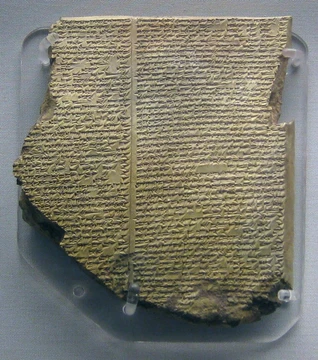
The Mesopotamian Epic of Gilgamesh, widely regarded as the first recorded epic poem, planted seeds that grew across nearly every major religious and mythological tradition. Its narrative tropes—a universal flood, a garden of life, a hero confronting a divine adversary—appear in parallel form in the Judeo-Christian Bible, where Utnapishtim becomes Noah, the Enkidu-and-Shamhat episode echoes the Adam-and-Eve story, and Gilgamesh's clash with Enkidu mirrors Jacob's struggle with an angel. Some anthropologists even identify Jesus as an embodiment of the same archetypal hero. The influence radiated outward to traditions as diverse as the Buddhist figure of Buddha, the Hindu Krishna, Greek heroes like Odysseus and Perseus, Egyptian deities including Ra and Osiris, the Roman founder Romulus, and the Zoroastrian figures of Zoroaster and Mithra. In a further ripple, the Bible reshaped the Arthurian legend, which had originally grown from pre-Christian Celtic folklore about a fifth- or sixth-century British warrior who repelled Saxon invaders. As the Church consolidated power in Britain, authors like Robert de Boron, who rendered the tale into French in 1155, wove in Christian symbolism—adding the sword-in-the-stone motif and giving Arthur twelve knights to mirror the twelve disciples.
From Royal Courts to the Written Page
The oldest form of epic storytelling was the folk epic, a tradition in which stories were sung or narrated live, often within the walls of royal courts. These performances recounted the mythologies of a given people, and because they were composed largely on the spot and transmitted purely by voice, the individuals behind them remain anonymous. Scholars presume these early performers were ordinary members of their communities rather than celebrated authors. Over time, a growing desire to preserve these narratives in a durable form and to credit their creators gave rise to the literary epic. While it retained the broad heroic themes of its folk predecessor, the literary epic was presented in written format, ensuring its survival across generations. Its structure and style tended to be more polished, coherent, and compact, drawing on the author's own learned knowledge rather than spontaneous oral invention. Crucially, the author of a literary epic was typically a recognized figure. Works like Homer's Iliad and Odyssey sit at the crossroads of these two modes, embodying the gradual shift from ephemeral court performance to the enduring written text.
A Genre That Refuses a Fixed Definition
For millennia, the epic existed comfortably within the boundaries of oral poetry, yet the genre has always resisted a single, tidy definition. Serious critical attempts to pin down what makes something truly "epic" only gained momentum in the past two centuries, as new storytelling mediums—novels, film, television, theater, and video games—began to emerge alongside advancing technologies. The rise of the novel proved especially disruptive: works like Tolstoy's War and Peace started being labeled "epic novels," forcing critics to reconsider the boundaries of the term. In response, "epic" evolved into a broad umbrella category encompassing subgenres such as epic poetry, epic novels, and epic films. Yet the very universality of the form, its presence across vastly different cultures and traditions, has made a definitive definition perpetually elusive. Today's literary academics still debate the core characteristics that distinguish an epic from other long-form narratives. Meanwhile, popular culture continues to draw on epic tropes, spawning genres like heroic fantasy, space opera, and high fantasy, with works such as Frank Herbert's Dune Saga inspiring everything from the Star Wars trilogy to Alejandro Jodorowsky's Jodoverse.
Frequently Asked Questions
What is A True Story?
It is a satirical short novel penned by the second-century Syrian author Lucian of Samosata. The piece lampoons the habit of ancient storytellers who dressed up absurd myths as if they were genuine reports.
What happens in A True Story?
The narrator is carried off to outer space, where he witnesses battles between alien inhabitants of different celestial bodies. His wild journey serves as a vehicle for Lucian to mock the credulity of audiences who accepted such tales at face value.
Why is A True Story famous?
It is recognized as the oldest known fictional work to feature space travel, extraterrestrial life, and warfare between planets. This has earned it a reputation as a foundational text for the science-fiction genre.
What genre is A True Story?
At its core it is a satire and parody targeting the outlandish claims found in earlier literary and historical sources. Readers today also read it as an early specimen of science fiction and fantasy.
What is the original Greek title of A True Story?
Lucian wrote it in Ancient Greek under the name Alēthē diēgēmata. The Latin equivalent, Vera Historia, is the form most commonly encountered in Western scholarly references.
More in Ancient Histories And Epics 1-17
Spotted an error? Know more?
This is a living reference — every entry is fact-audited, and reader corrections feed straight into our audit queue. Suggest an edit · See this site's audit record