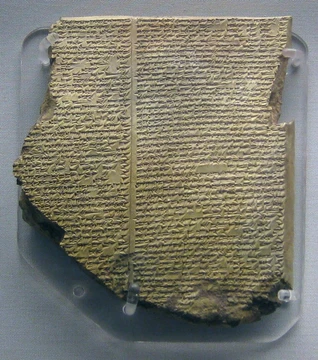
Antiquities of the Jews
A 20-volume Greek history of the Jewish people by Josephus.

Antiquities of the Jews is a 20-volume historiographical work written in Greek by the Roman-Jewish historian Josephus in 94 CE, during the 13th year of the reign of the Roman emperor Domitian. It provides an account of Jewish history from the creation of Adam and Eve up to the First Jewish–Roman War (66–73 CE), intended for Josephus's gentile patrons. The work is a vital source for the intertestamental period and early Christian era, offering valuable background for historians of 1st-century Judaism.
- author
- Josephus
- year_composed
- 94 CE
- language
- Greek
- volumes
- 20
- field
- Historiography
- known_for
- Account of Jewish history from creation to the First Jewish–Roman War
Lore & Background
To appeal to a Greco-Roman audience, Josephus omitted certain biblical accounts, such as the Song of the Sea, and added Hellenistic elements, like describing Moses' song in hexameter. He also omitted the golden calf episode, possibly to avoid pagan antisemitic allegations. Josephus stated that Egyptian taskmasters forced Jewish slaves to build pyramids. The work includes a short autobiographical appendix, Vita. The extant copies contain two passages about Jesus and James the Just; the longer one, the Testimonium Flavianum, is considered authentic but possibly subject to Christian interpolation.
Reader's Guide
Antiquities of the Jews is considered a significant single work from the Roman Empire, as it presents Jewish history as an unbroken sequence from creation to Josephus's own day, exemplifying the survival of Jewish historical consciousness under Roman rule. It contains valuable historical material on Hellenistic states, Parthia, Armenia, the Nabatean kingdom, and Rome. In the Middle Ages and modern times, it was regarded as a key source for ancient Roman history, alongside works by Livy, Tacitus, Suetonius, and Jerome. The work circulated widely in Latin translation and was translated into Old Bulgarian in the 10th century. The Loeb Classical Library edition by Thackeray and Marcus is academically preferred.
Did You Know?
- Josephus omitted the golden calf episode from his account, possibly to avoid pagan antisemitic allegations.
- The earliest Greek manuscript of Books 11–20 dates from the 11th century and is preserved in Milan.
- The work was translated into Old Bulgarian at the Preslav Literary School in the early 10th century.
Archaeological Traces of Ancient Jewish Iberia
The physical record of Jewish life in the Iberian Peninsula stretches remarkably far back. A first-century amphora unearthed on the island of Ibiza carries two Hebrew characters, hinting at commercial links between Judaea and the Balearic Islands. In Cádiz, a signet ring dating to the eighth or seventh century BCE bears an inscription that most scholars read as Phoenician, though a minority interpret it as paleo-Hebraic, opening the door to a far earlier Jewish footprint. Two trilingual Jewish inscriptions from Tarragona and Tortosa, spanning the second century BCE to the sixth century CE, provide additional textual anchors. On the funerary front, a third-century tombstone in Adra commemorates a Jewish infant named Annia Salomonula, while a roughly contemporaneous epitaph in Villamesías records a freedman, Alucius Roscius, who explicitly identifies himself as Jewish. A second-century gravestone discovered in Mérida is often cited as the earliest unambiguous archaeological proof of Hebrew presence in the peninsula. Together, these artifacts paint a picture of a community whose roots may reach into the biblical era, even if the most solid evidence clusters around the first few centuries of the Common Era.
Literary and Rabbinic Testimony to Jewish Spain
Beyond stone and clay, a rich thread of textual sources confirms Jewish communities in Roman-era Spain. Paul the Apostle, in his Epistle to the Romans, expresses a plan to travel to Spain to preach, a detail many scholars take as indirect evidence of established Jewish congregations by the mid-first century. Flavius Josephus offers a more tangled testimony: in The Jewish War he places the exile of Herod Antipas under Caligula in Spain, yet in his later Antiquities of the Jews he relocates the banishment to Gaul. Rabbinic literature from around the same period is more straightforward. The Mishnah, redacted near 200 CE, implies a functioning Jewish community in Spain in communication with the Land of Israel. A tradition attributed to second-century tanna Rabbi Meir, transmitted through Rabbi Berekhiah and Rabbi Shimon bar Yochai, speaks of divine help arriving from Gaul, from Spain, and from their neighbors. Slightly later, Midrash Rabbah and the Pesikta de-Rav Kahana both reference the Spanish diaspora and its eventual return. The Council of Elvira, convened in the early fourth century, issued decrees regulating Christian-Jewish interaction, including a ban on intermarriage, confirming that Jewish life was visible enough to provoke ecclesiastical legislation.
Community Formation in Roman Hispania
The consolidation of Jewish communities in the Iberian Peninsula is generally linked to the upheavals following Rome's conquest of Judea. After the destruction of the Second Temple in 70 CE, waves of immigration are thought to have reached Hispania, a province that had fallen under Roman control after the Second Punic War. Some scholars speculate that as many as eighty thousand Jews were carried to Spain during the Jewish-Roman War under Vespasian and Titus, though this figure is widely regarded as uncertain. These early arrivals, whether free citizens or enslaved persons dispersed to the empire's western reaches, likely established footholds several generations before the third century. As Roman citizens, Jews in Hispania participated in diverse economic activities, including agriculture, and maintained close social ties with non-Jewish neighbors. The Synod of Elvira's edicts, while reflecting early priestly antisemitism, paradoxically attest to a level of integration that alarmed Christian authorities. Subsequent immigration continued along both the North African and southern European shores of the Mediterranean, gradually building the well-established communities whose existence is confirmed by third-century material evidence.
From Al-Andalus to the Alhambra Decree
The Umayyad conquest of Hispania in the early eighth century placed Jews under the Dhimmi system, and over time many progressively Arabised. The tenth and eleventh centuries, spanning the caliphal and early taifa periods, marked a cultural zenith: systematic scientific and philological study of the Hebrew Bible took root, and secular poetry was composed in Hebrew for the first time. The Almoravid and Almohad invasions shattered this world, driving many Jews toward North Africa and the Christian kingdoms of the peninsula. In those Christian realms, the fourteenth century brought escalating persecution and antisemitic mob violence, culminating in the devastating pogroms of 1391. The Alhambra Decree of 1492 forced a stark choice upon the remaining practising Jews of Castile and Aragon: convert to Catholicism and become New Christians, subject to the discriminatory limpieza de sangre system, or face expulsion. An estimated one hundred to two hundred thousand chose exile, seeding diaspora communities across the Mediterranean and beyond. Tracing back to a 1924 decree, modern Spain has pursued policies facilitating the return of Sephardi descendants by granting citizenship on the basis of demonstrated ancestry. Today, an estimated forty to fifty thousand Jews reside in the country.
Frequently Asked Questions
What is Antiquities of the Jews?
It is a 20-volume historical account of the Jewish people, authored by the Roman-Jewish scholar Josephus. The text walks readers from the biblical story of Adam and Eve all the way through the First Jewish–Roman War that ended in 73 CE.
Who wrote Antiquities of the Jews and when was it composed?
Josephus, a historian who lived under Roman rule, finished the work in 94 CE, during the 13th year of Emperor Domitian's reign. He chose to write in Greek so that his non-Jewish audience could follow the narrative.
What time period does Antiquities of the Jews cover?
The narrative stretches from the creation of the world in the Genesis account to the fall of the Jewish revolt against Rome in 73 CE. This makes it a rare window into the centuries between the Old and New Testaments and into the earliest decades of Christianity.
Why do historians consider Antiquities of the Jews so important?
It remains one of the most detailed primary sources for understanding how Jewish communities lived, governed themselves, and interpreted their own sacred texts in the first century. Because Josephus was addressing a Roman readership, the work also reveals how Jewish identity was framed for outsiders.
Who was Antiquities of the Jews originally intended for?
Josephus wrote the text for his gentile patrons—Roman-speaking readers outside the Jewish community who were curious about Jewish origins and traditions. By composing it in Greek rather than in Hebrew or Aramaic, he made the material accessible to a broad educated audience across the empire.
More in Ancient Histories And Epics 1-17
Spotted an error? Know more?
This is a living reference — every entry is fact-audited, and reader corrections feed straight into our audit queue. Suggest an edit · See this site's audit record