Book of Han
First dynastic history in annals-biography form, covering the Former Han.

The work was composed by Ban Gu (32–92 CE), an Eastern Han court official, with the help of his sister Ban Zhao, continuing the work of their father, Ban Biao. It is the best source, sometimes the only one, for many topics such as literature in this period.
- primary_author
- Ban Gu (32–92 CE)
- contributors
- Ban Zhao, Ban Biao, Ma Xu
- format
- Jizhuanti (annals-biography form)
- fascicles
- 100
- canon
- One of the Twenty-Four Histories and the 'Four Histories'
Lore & Background
The Book of Han developed from a continuation of Sima Qian's Records of the Grand Historian, initiated by Ban Gu's father, Ban Biao, at the beginning of the Later Han dynasty. After Ban Biao's death, his eldest son Ban Gu was dissatisfied with what his father had completed and began a new history starting with the beginning of the Han dynasty, distinguishing it from Sima Qian's work. Ban Gu initiated the Jizhuanti format for dynastic histories, which remained the model for official histories until modern times. For overlapping periods, Ban Gu adopted nearly verbatim much of Sima Qian's material, though in some cases he expanded it, and also incorporated at least some of his father's writing.
Reader's Guide
The Book of Han set the standard for the writings of later Chinese dynasties and today is a reference used to study the Han period. It is regarded as one of the 'Four Histories' of the Twenty-Four Histories canon, together with the Records of the Grand Historian, Records of the Three Kingdoms, and History of the Later Han. The work includes essays on law, science, geography, and literature, and its 100 fascicles cover annals, chronological tables, treatises, and biographies. The text provides the first unambiguous written appearance of the people of Japan, recording that 'The people of Wo are located across the ocean from Lelang Commandery, are divided into more than one hundred tribes, and come to offer tribute from time to time.' It also records that in 57 CE, the southern Wa kingdom of Na sent an emissary and received a golden seal, later discovered in northern Kyūshū in the 18th century.
Did You Know?
- It is the first Chinese dynastic history to use the annals-biography (Jizhuanti) format for a single dynasty.
- The book contains the first unambiguous written record of Japan, referring to the people of Wo.
- The golden seal given to the Wa kingdom of Na in 57 CE was discovered in northern Kyūshū in the 18th century.
Media and Genres of the Ancient Written Word
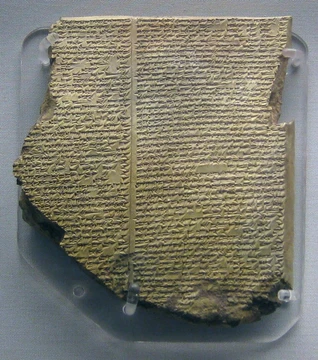
Ancient literature encompasses an astonishing range of written forms, from religious and scientific documents to tales, poetry, and dramatic works. Royal edicts and declarations also form part of this vast corpus, demonstrating that the impulse to commit ideas to durable form was not limited to artistic expression but extended to governance and administration as well. The physical carriers of these texts were equally varied: scribes and authors worked with stone, clay tablets, papyri, palm leaves, and even metal, choosing materials that suited the permanence or portability they required. Before the invention of writing itself, oral traditions carried stories, laws, and prayers from generation to generation, yet this mode of transmission was fragile. Many spoken works simply vanished, while a fortunate few survived as fragments or were later transcribed. The result is a patchwork record in which some civilizations left behind dense archives and others are known only through scattered remnants, reminding us that the written word, for all its durability, still cannot guarantee that every voice will reach the present day.
The Dawn of the Written Record
The earliest surviving written literature stretches back to roughly 2600 BC, when Sumerian scribes in southern Mesopotamia produced texts such as the Instructions of Shuruppak and a hymn dedicated to the temple at Kesh. Almost contemporaneously, Egyptian authors at Saqqara composed the Life of Metjen, while a generation later they recorded the Diary of Merer and the Instruction of Hardjedef around 2500 BC. The Sumerians of that same era gave us the Hymn to Enlil, the myth of Enlil and Ninlil, and a whimsical debate between sheep and grain. By 2400 BC, the Code of Urukagina had been inscribed, and the Egyptian Pyramid Texts, including the striking Cannibal Hymn, were taking shape. These early compositions reveal that the very first literate societies were already producing a remarkable diversity of genres: legal codes, religious hymns, practical instructions, and narrative poetry all emerged within a narrow window of a few centuries, establishing patterns that would echo through every subsequent literary tradition.
Survival, Loss, and the Long Shadow of Time
One of the most sobering realities of ancient literature is that an unknown number of written works have simply not survived the ravages of time. The gap between what was once composed and what we can still read is vast and largely unmeasurable. Before writing existed at all, oral literature was the primary vessel for stories, laws, and prayers, yet this mode was inherently precarious; many spoken traditions dissolved without leaving a trace, while a fortunate minority persisted as fragments or were eventually committed to a physical medium. Even after texts were inscribed or written down, their survival was far from assured. The Egyptian Book of the Dead, for instance, appears in the Papyrus of Ani around 1240 BC, yet other versions of the same work likely date back to the 18th century BC, meaning that centuries of earlier copies are now gone. The Epic of Gilgamesh illustrates a similar pattern: its earliest Sumerian stories span 2250 to 2000 BC, a complete version appeared by 1800 BC, and Akkadian retellings continued into the 9th century BC, but countless intermediate iterations have been lost forever.
A Multilingual Tapestry of Civilizations
The corpus of ancient literature is not the product of a single culture but a multilingual tapestry woven across continents and millennia. Sumerian, Egyptian, Akkadian, Hittite, Ugaritic, Sanskrit, Greek, and Chinese authors all contributed to a shared human record that spans from 2600 BC to the 7th century BC. The genres are equally varied: legal codes like those of Ur-Nammu and Hammurabi; great epics such as Gilgamesh, the Iliad, and the Odyssey; hymns to deities; mathematical papyri like the Rhind and Moscow examples; and philosophical works such as the Upanishads of the 8th century BC. The Sanskrit tradition produced the Rig Veda between 1500 and 1000 BC, followed by the Shulba Sutras containing geometry for fire-altar construction, and the great Upanishadic texts. Greek letters in the 8th and 7th centuries BC brought the Trojan War cycle, Hesiod's Theogony and Works and Days, and the poetry of Archilochus and Alcman. Together these works demonstrate that the impulse to record, interpret, and celebrate human experience was a universal drive, expressed in dozens of languages and on every available surface from clay to papyrus to stone.
Frequently Asked Questions
Who wrote the Book of Han?
Ban Gu (32–92 CE), an Eastern Han court official, is the primary author, though he built on the unfinished work of his father Ban Biao. His sister Ban Zhao and the scholar Ma Xu also contributed to seeing the text through to completion.
What makes the Book of Han different from other dynastic histories?
It is the first of the Twenty-Four Histories to employ the jizhuanti (annals-biography) format, weaving chronological annals together with individual biographies and thematic treatises. This structural model became the standard for every official dynastic history that followed.
Why do scholars rely so heavily on the Book of Han?
For many subjects—especially literature, geography, and relations with neighboring peoples during the Former Han era—it is the sole surviving source. Its detailed biographies and thematic chapters preserve information that no other text from that period provides.
More in Ancient Histories And Epics 1-17
Spotted an error? Know more?
This is a living reference — every entry is fact-audited, and reader corrections feed straight into our audit queue. Suggest an edit · See this site's audit record