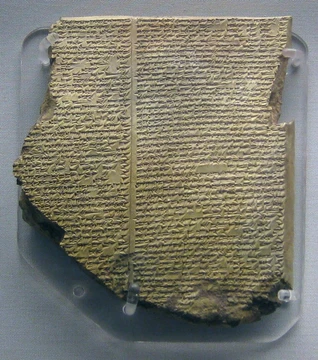
Cyrus Cylinder
Ancient clay cylinder with Achaemenid inscription praising Cyrus the Great.

The Cyrus Cylinder is an ancient clay cylinder, now broken into several pieces, on which is written an Achaemenid royal inscription in Akkadian cuneiform script in the name of the Persian king Cyrus the Great. It dates from the 6th century BC and was discovered in the ruins of the ancient Mesopotamian city of Babylon (now in modern Iraq) in 1879. It is currently in the possession of the British Museum. It was created and used as a foundation deposit following the Persian conquest of Babylon in 539 BC, when the Neo-Babylonian Empire was invaded by Cyrus and incorporated into his Persian Empire.
- material
- Baked clay
- dimensions
- 22.5 cm by 10 cm at maximum diameter
- date_of_origin
- Between 539 and 530 BC
- discovered
- March 1879
- discovered_by
- Hormuzd Rassam
- current_location
- British Museum
- script
- Akkadian cuneiform
Verified Timeline
Lore & Background
The Cyrus Cylinder was discovered in March 1879 by the Assyro-British archaeologist Hormuzd Rassam during a lengthy programme of excavations in Mesopotamia carried out for the British Museum. It had been placed as a foundation deposit in the foundations of the Ésagila, the city's main temple. Rassam's expedition followed on from an earlier dig carried out in 1850 by the British archaeologist Austen Henry Layard, who excavated three mounds in the same area but found little of importance. The discovery was announced to the public by Sir Henry Rawlinson, the President of the Royal Asiatic Society, at a meeting of the Society on 17 November 1879. The Cylinder is a barrel-shaped cylinder of baked clay measuring 22.5 centimetres by 10 centimetres at its maximum diameter. It was created in several stages around a cone-shaped core of clay within which there are large grey stone inclusions. It was excavated in several fragments, having apparently broken apart in antiquity. Today it exists in two main fragments, known as 'A' and 'B', which were reunited in 1972. The smaller fragment, 'B', was acquired by J.B. Nies of Yale University from an antiquities dealer and was not confirmed as part of the Cylinder until Paul-Richard Berger of the University of Münster definitively identified it in 1970.
Reader's Guide
The Cyrus Cylinder's text praises Cyrus, sets out his genealogy and portrays him as a king from a line of kings. The Babylonian king Nabonidus, who was defeated and deposed by Cyrus, is denounced as an impious oppressor of the people of Babylonia. The victorious Cyrus is portrayed as having been chosen by the chief Babylonian god Marduk to restore peace and order to the Babylonians. The text states that Cyrus was welcomed by the people of Babylon as their new ruler and entered the city in peace. It extols Cyrus as a benefactor of the citizens of Babylonia who improved their lives, repatriated displaced people and restored temples and cult sanctuaries across Mesopotamia and elsewhere in the region. The Cylinder's text has traditionally been seen by biblical scholars as corroborative evidence of Cyrus' policy of the repatriation of the Jewish people following their Babylonian captivity, as the text refers to the restoration of cult sanctuaries and repatriation of deported peoples. This interpretation has been disputed, as the text identifies only Mesopotamian sanctuaries, and makes no mention of Jews, Jerusalem, or Judea. In modern times, the Cylinder was adopted as a national symbol of Iran by the ruling Pahlavi dynasty, which put it on display in Tehran in 1971 to commemorate the 2,500-year celebration of the Persian Empire. Princess Ashraf Pahlavi presented United Nations Secretary General U Thant with a replica of the Cylinder. Her brother, Shah Mohammad Reza Pahlavi, promoted the Cylinder as the 'first charter of human rights', though this interpretation has been described by most historians as 'rather anachronistic' and controversial.
Did You Know?
- The Cyrus Cylinder was discovered in March 1879 by Hormuzd Rassam during excavations for the British Museum.
- It was placed as a foundation deposit in the foundations of the Ésagila, Babylon's main temple.
- The Cylinder exists in two main fragments, 'A' and 'B', which were reunited in 1972.
- Fragment 'B' was acquired by J.B. Nies of Yale University and identified as part of the Cylinder by Paul-Richard Berger in 1970.
- The text consists of 45 lines of Akkadian cuneiform script, with the first 35 lines on fragment 'A'.
Frequently Asked Questions
What is the Cyrus Cylinder?
It is a small baked-clay cylinder, roughly 22.5 cm in length, bearing an Achaemenid royal inscription in Akkadian cuneiform that honors the Persian king Cyrus the Great. The object was produced as a foundation deposit after Cyrus's forces captured Babylon in 539 BC, bringing the Neo-Babylonian Empire under Persian rule.
Who discovered the Cyrus Cylinder and where was it found?
The broken fragments were pulled from the ruins of ancient Babylon in March 1879 by the excavator Hormuzd Rassam. The site lies in what is now modern-day Iraq, and the pieces were later reassembled into the single artifact known today.
Where is the Cyrus Cylinder kept today?
The reassembled cylinder is part of the permanent collection at the British Museum in London. It has been accessible to the public there since the late 19th century and remains one of the museum's most frequently viewed ancient objects.
What script and language does the Cyrus Cylinder use?
The text is carved in Akkadian cuneiform, the wedge-shaped writing system long standard across Mesopotamian administration. Although Cyrus was a Persian Achaemenid ruler, the inscription was deliberately composed in the local language so Babylonian readers could understand its message.
Why is the Cyrus Cylinder important to the study of ancient history?
It provides a rare first-person royal account of the Persian takeover of Babylon and the political shift from the Neo-Babylonian to the Achaemenid Empire. Because it was sealed as a foundation deposit, the clay survived well enough to preserve Cyrus's own framing of his legitimacy and governance for over two millennia.
More in Ancient Histories And Epics 1-17
Spotted an error? Know more?
This is a living reference — every entry is fact-audited, and reader corrections feed straight into our audit queue. Suggest an edit · See this site's audit record